EMT Practice Test

1. Question Content...


Question List

Question1: An organization adopts Agile practices and implements an incremental delivery strategy. If implemented correctly, the company should recognize improved:

Question2: In eXtreme Programming (XP), analysis, design, coding, and testing phases are done:

Question3: Scrum users must frequently review Scrum artifacts and progress toward a Sprint Goal to detect undesirable variances. Which pillar of Scrum does this represent?

Question4: An organization adopts Agile practices and implements an incremental delivery strategy. If implemented correctly, the company should recognize improved:

Question5: Prior to a retrospective, discussions among team members indicate conflict. An agile practitioner wants to ensure an open and safe environment during the retrospective.
What should the agile practitioner do?

Question6: Which chart shows the total number of story points completed through the end of each iteration?

Question7: What is the responsibility of an extreme Programming (XP) customer role?

Question8: A project team estimates that they should complete 30 story points in the current iteration. Partway through the iteration they realize that they will complete 50 story points at their current rate. The team should:

Question9: In a vision meeting, the vision for the project is defined and presented by the:

Question10: Which of the following is a list of valid Agile project planning practices?

Question11: In a Lean Software Development environment, the Project Leader strives to eliminate:

Question12: Who typically has the best insight into task execution?

Question13: What is the common communication bridge between the team and the Product Owner?

Question14: A company has decided to combine two similar products consisting of multiple teams into one product. Engaged customers want to know how the company is looking at re-organizing it's teams.
What strategy should be employed to re-organize the teams?

Question15: CRUD is an acronym that defines a way to split stories. What does CRUD stand for?

Question16: A company is moving into a new space and is determining the best configuration for offices. The management team is also considering moving to an agile process. What advice should an agilist give?

Question17: An agile team member identifies a potential problem within the project team How should the team's coach react?

Question18: What is the definition of velocity?

Question19: An agile project leader is delivering a team kick-off session. The first exercise is a "Life Timeline" - a story-telling exercise where each team member tells their life story, explains how they experienced the highs and lows of their journey, and identifies their fears and hopes.
What is the project leader trying to create?

Question20: Refactoring, as it applies to the practice of extreme Programming (XP), refers to:

Question21: An angle team is working on a new product. To ensure that all unknown issues are clarified before committing to the scope, the team plans to work only on spike user stories for the next three sprints.
What should the agile coach do in this situation?

Question22: The process of reviewing, testing, and accepting implemented features is called:

Question23: Based on the following figure, during Iteration 5, there was an increase in story point value (shown on the graph); however, the team completed all of the work it promised to deliver in the iteration and existing estimates were not changed. From this information, one can inferthat:

Question24: Who is responsible for ordering the Product Backlog?

Question25: In Agile,________________is the primary measure of progress:

Question26: On a project using eXtreme Programming (XP), a customer test is a:

Question27: When does Adaptation occur in Scrum?

Question28: Which list below includes the attributes of a good User Story?

Question29: Suppose you are performing integrated testing on each of the different product increments developed during an iteration to ensure that the increments work together as a whole. What type of iteration is this?

Question30: During the iteration planning of a newly onboarded agile team, the product owner adds a set of high priority user stories into the iteration backlog.
What should the team do first to define the tasks needed to implement the user stories?

Question31: How is the participatory design process characterized?

Question32: What is a high-level representation of the features or themes that are to be delivered in each release?

Question33: An event management team is following an agile approach to prepare for an upcoming conference. The regional sales manager, from where the conference is to be held, contacts the team with a number of questions about the company's booth.
What should the team do?

Question34: A common reason a story may not be estimable is the:

Question35: What does Scrum mean by Transparency?

Question36: No one but the Scrum Team attends the Sprint Planning meeting.

Question37: At a strategic level, what is the most appropriate way for an Agile team to estimate a project?

Question38: Which is NOT a role on an XP team?

Question39: An executive sponsor of a new scrum team actively attends scrum ceremonies.
How does this benefit the team?

Question40: In a Lean Software Development environment, the Project Leader strives to eliminate:

Question41: The best description of a Sprint backlog is:

Question42: The Agile Manifesto value "customer collaboration over contract negotiation" means that:

Question43: At a strategic level, what is the most appropriate way for an Agile team to estimate a project?

Question44: Which of the following is an example of an information radiator?

Question45: During a team meeting, members who are subject matter experts (SMEs) mention that they are continuously working on repetitive tasks, which has lowered motivation.
What should the agile practitioner do?

Question46: After three iterations, the problems impeding an Agile team appear to be similar in nature to problems faced in earlier iterations. Inspection of the retrospectives for past iterations reveals information organized into columns entitled "What worked for us" and "What did not work for us. " Based on this information, one can infer that the team did not capture:

Question47: Which is the best option to improve project velocity?
Question48: Midway through a project, the product owner learns from the sponsor that a major component, which is already
20 percent complete, is unimportant to users. The component was part of the approved scope and a key selling point for the project.
What should the product owner do next?

Question49: During planning sessions, an agile practitioner notices that some team members do not share common ideas. What should the agile practitioner do?

Question50: During a current sprint a learn member asks permission horn the scrum master lo investigate an alternative design approach What should the scum master do?

Question51: A team is creating a highly marketed, time-sensitive product. The agile coach is concerned that anything other than exceptional quality will result in bad publicity for the company.
What should the agile coach ensure that developers do?

Question52: An organization initiates a pilot project to introduce agile methodology for the successful delivery of projects.
What should the project manager do to share this project's knowledge and learning with wider organizational business groups?

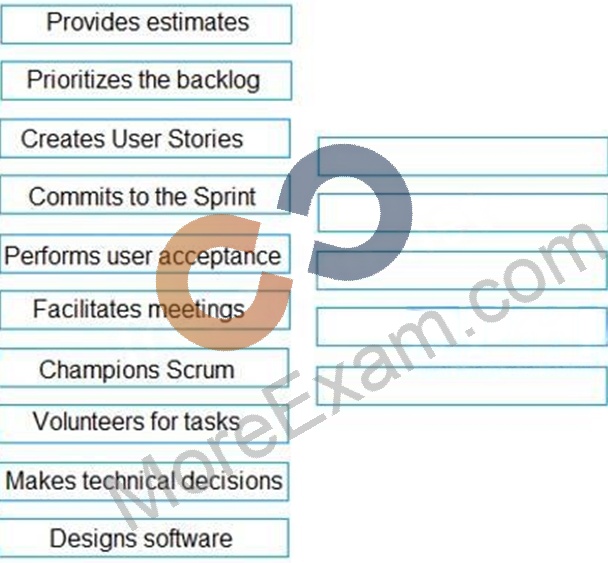
Question53: Drag and Drop Question
Pick 5 activities that are the responsibilities of the development team in Scrum.

Question54: Which of the following is a list of valid Agile project planning practices?

Question55: Classes of Services in Kanban are used to:

Question56: A newly formed scrum team wants to foster an environment of transparency and experimentation. The team decides to use a Kanban board to record and track encountered impediments. Emphasis is placed on how issues are resolved and the strategies for preventing them in the future.
Over time, what will be the result of this approach?

Question57: Why should an agile coach model agile principles and behaviors, become self-aware, and be present?

Question58: A business analyst has identified a new risk in an Agile project. What is the best first step the business analyst should take regarding this risk?

Question59: During a review session an agile team presented done requirements to a group of stakeholders Stakeholder feedback indicated that the done requirements failed to meet the most pressing needs and provide value What should the team have done to prevent this?

Question60: The team estimation game method mainly consists of a:

Question61: Who is responsible for prioritizing the stories that will be included in the iteration?

Question62: Question: Which of the following BEST describes ROTI?

Question63: After three iterations, it is identified that a project's underlying security structure architecture is unstable. While there is a technical solution, all work to date is flawed. This will impact several future business service offerings.
What should the product owner do to resolve this?

Question64: Name the XP technique where two people pair; one person who codes is the driver and the other person who thinks is the Navigator?

Question65: The three questions asked at every Daily Scrum should be: "What have you accomplished since the last Daily Scrum?";"What are you planning to accomplish between now and the next Daily Scrum?"; and:

Question66: This role would be responsible for determining when a release can occur:

Question67: In a burndown chart, if the remaining work line is above the expected work line, what does this signify?

Question68: Drag and Drop Question
What is the correct sequence of activities in release planning?

Question69: An organization highly values security. However, a team member on a project has found a way to save time and money with less robust security features.
What should the team member do?

Question70: A development team has finished identifying the tasks they will be accountable for during the next sprint. Which of the following tools best provides transparency into the progress throughout the sprint?

Question71: Midway through a project, the product owner learns from the sponsor that a major component, which is already 20 percent complete, is unimportant to users. The component was part of the approved scope and a key selling point for the project.
What should the product owner do next?

Question72: Which of the following drivers is the most important factor in determining the order in which stories will be developed?

Question73: Which of the following is NOT a principle from the Agile Manifesto?

Question74: When an Agile project team receives an "emergency request" during an iteration, which is the best first step that the Agile project manager should take?

Question75: An agile practitioner wants to ensure that stakeholders have current information about a project's progress.
What should the agile practitioner do?

Question76: Which type of estimate refers to estimating a story based on its relationship to one or more other stories?

Question77: A key stakeholder cannot attend the project vision statement development workshop. The stakeholder has emailed their requirements to the agile team lead, and believes that the vision statement is not critical.
How should the agile team lead respond?

Question78: Who updates work remaining during the Sprint?

Question79: When interacting with team members, the Agile project manager should:

Question80: The team is in the middle of an iteration and there is an urgent request for a small change to be introduced to the committed scope. Unless this change is accepted, there is no value to the customers during this iteration.
What must the agile practitioner do?

Question81: A project team meets to estimate user stories for a sprint. While an important non-functional requirement must be delivered in the sprint, the estimate exceeds sprint capacity.
What should the team do?

Question82: How is the participatory design process characterized?

Question83: On XP teams, what is expected from the Project Manager?

Question84: Every Project Management Life Cycle (PMLC) has a sequence of processes that include these phases:

Question85: Which of the following is an Agile practice promoted by XP that is often used on conjunction with other Agile methods?

Question86: An experienced product owner presents the epics and corresponding stones during a release planning session with the established team The executive sponsor asks the team when the features will he delivered What should the agile team do?

Question87: What should a learn do when they complete ail sprint goals earlier than expected?

Question88: Sequence the steps to User Story Mapping.

Question89: An agile team identifies that their velocity is lower than predicted, and that their previous forecasts in the product roadmap are wrong. The team is worried that they will be unable to meet a critical release date without corrective action.
What should the team do?

Question90: During the iteration planning of a newly onboarded agile team, the product owner adds a set of high priority user stories into the iteration backlog.
What should the team do first to define the tasks needed to implement the user stories?

Question91: The agile practitioner has determined that two different team members are working on addressing the same major issue on the project.
How should the agile practitioner address this?

Question92: During planning sessions, an agile practitioner notices that some team members do not share common ideas.
What should the agile practitioner do?

Question93: The person responsible for the Scrum process, making sure it is used correctly and maximizing its benefit:

Question94: At a strategic level, what is the most appropriate way for an Agile team to estimate a project?

Question95: A team identifies the number of threats and lists them in the order in which they were identified.
After analyzing a cause-and-effect diagram, the ownership of the threats and their treatment is assigned, and a number of risk cards are placed on the Kanban board.
What approach should be used to manage these threats?

Question96: What role should a servant leader perform to reduce team distractions and improve progress toward project goals?

Question97: Outing a review session a customer representative is concerned that a story fails to satisfy the scope of work. However the product owner declares that the scope of work is complete What should be done with this story?

Question98: Which of the following is an Agile improvement technique to address issues continuously, e.g. after daily stand-up?

Question99: The 3 items are required for an Agile, adaptive environment: (Choose three.)

Question100: All of the following occur in the second half of the Sprint planning meeting EXCEPT:

Question101: On Agile teams, conflict is to be avoided at all cost.

Question102: Which of the following is NOT one of the 12 core practices of XP:

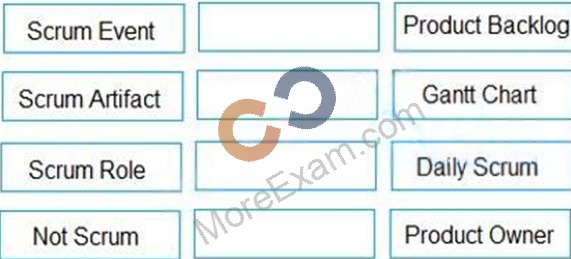
Question103: Drag and Drop Question
Match the following:
Question104: What are the primary outputs of a release planning session?

Question105: Continuous integration ensures that a product is:

Question106: Teams of members working in different physical locations are called:

Question107: A member of the development team is working on a prioritized non-functional requirement involving integrating with a 3rd party system This integration has not been done before on the project.
What should the project leader suggest?

Question108: Of the listed options, which BEST describes User Stories?

Question109: When using Agile Earned Value Management (EVM), progress should be measured at which level?

Question110: The primary purpose of a Sprint Review is for the team to:

Question111: A development team, new to scrum, questions the need to collect metrics on team performance.
While team members understand velocity and burn down, they feel that once velocity becomes settled it is needless to keep track.
What should the agile coach tell the team?

Question112: A common reason that a story may not be estimable is that the:

Question113: How can a scrum team obtain more feedback from a minimally responsive outside stakeholder?

Question114: User stories are temporary artifacts. They are considered relevant until the:

Question115: Analyzing the current organizational processes, per project requirements, and making needed process changes is called:

Question116: During the iteration planning of a newly onboarded agile team, the product owner adds a set of high priority user stones into the iteration backlog What should the team do first to define the tasks needed to implement the user stories?

Question117: Acronym describing the attributes of a product backlog:

Question118: All of the following are metrics used in Agile except:

Question119: Team velocity is used to:

Question120: Midway through an iteration, an agile team learns that a team member will be unavailable for the next two iterations.
As a high-performance team, what should the team do?

Question121: The smallest amount of functionality that delivers customer value is best described as a:

Question122: Which of the following is a list of capabilities, features, and stories that the Product Owner has identified?

Question123: A full cycle of design-code-verifyrelease practiced by extreme Programming (XP) teams is called:

Question124: Which XP practice promotes the restriction on overtime?

Question125: Which of the following defines the goal of testing in Lean software development?

Question126: An agile team discovers a new risk and identifies that its impact may be severe. What should an agile practitioner recommend?

Question127: The Scrum Master as a Servant Leader is in service to which of the following?

Question128: A project team identifies a number of technical challenges with features in the next sprint. What should they do?

Question129: One of the major tools and techniques used in Lean Software Development is Value Stream Mapping. What is the primary purpose of value stream mapping?

Question130: What is one of the benefits of incremental delivery?

Question131: During the daily standup meeting, a team member states that an issue has been encountered. This leads to the team members getting into a problem-solving discussion. How should the ScrumMaster respond?

Question132: For a one month Sprint, what is the recommended duration of the Sprint Planning meeting?

Question133: Which artifact is useful for seeing total project risk increasing or decreasing over time?

Question134: Retrospectives provide an opportunity for the team to:

Question135: Which Agile method goes through the following stages:

Question136: The following is a picture of which of the following Information Radiators?

Question137: Estimating costs for an Agile project starts with which of the following types of meetings?

Question138: What are the three pillars of Scrum?

Question139: At the retrospective, the burndown chart shows that the project is slightly behind schedule. The project team identifies an inexperienced software engineer as the source of reduced velocity-How should the project team address this issue?

Question140: Match each component of the Agile Triangle (on the left) to its associated description (on the right)

Question141: After seeing the planned features for an upcoming release, a customer notes that a vitally important and complex one is missing. The team estimates that this feature significantly exceeds its average velocity.
How can this issue be resolved?

Question142: Estimating costs for an Agile project starts with which of the following types of meetings?

Question143: Which term best describes an Agile project's approach to risk analysis?